.svg)

Keyword research has traditionally meant bouncing between SEO tools, exporting spreadsheets, sorting through hundreds of keywords, and manually grouping opportunities.
AI is starting to change that workflow.
With Semrush MCP, marketers can connect Semrush directly to AI assistants like ChatGPT and Claude. Instead of asking AI to guess which keywords might be valuable, you can give it access to real Semrush data and ask questions in natural language.
For D2C and ecommerce brands managing hundreds of products, collections, and content opportunities, that can make keyword research considerably faster.
What Is Semrush MCP?
MCP, or Model Context Protocol, allows an AI assistant to connect to external tools and data sources.
Semrush MCP essentially creates a bridge between Semrush and tools like ChatGPT or Claude. Once connected, the AI can retrieve Semrush data as part of your conversation, including:
- Search volume
- Keyword difficulty
- Related keywords
- Ranking positions
- SERP features
- CPC
- Competitor keywords and overlap
- Organic traffic estimates
The important distinction is data access versus AI guesswork.
ChatGPT and Claude are useful for brainstorming keywords on their own, but they should not be treated as keyword databases. Connecting Semrush lets you combine AI's ability to organize and analyze information with actual search data.
How AI Keyword Research Changes the Traditional SEO Workflow
Consider an ecommerce brand selling women's activewear.
A traditional workflow might involve entering "workout leggings" into a keyword tool, reviewing variations, exporting the results, filtering them, checking competitors, and manually separating keywords into product, collection, and blog opportunities.
With Semrush connected, you can instead ask:
“Find relevant non-branded keywords related to women's workout leggings in the U.S. Separate them by product, collection, and informational intent. Include monthly search volume and keyword difficulty, then identify opportunities with the best balance of relevance, volume, and ranking difficulty.”
The AI can retrieve the data and organize it around the actual SEO decision you are trying to make.
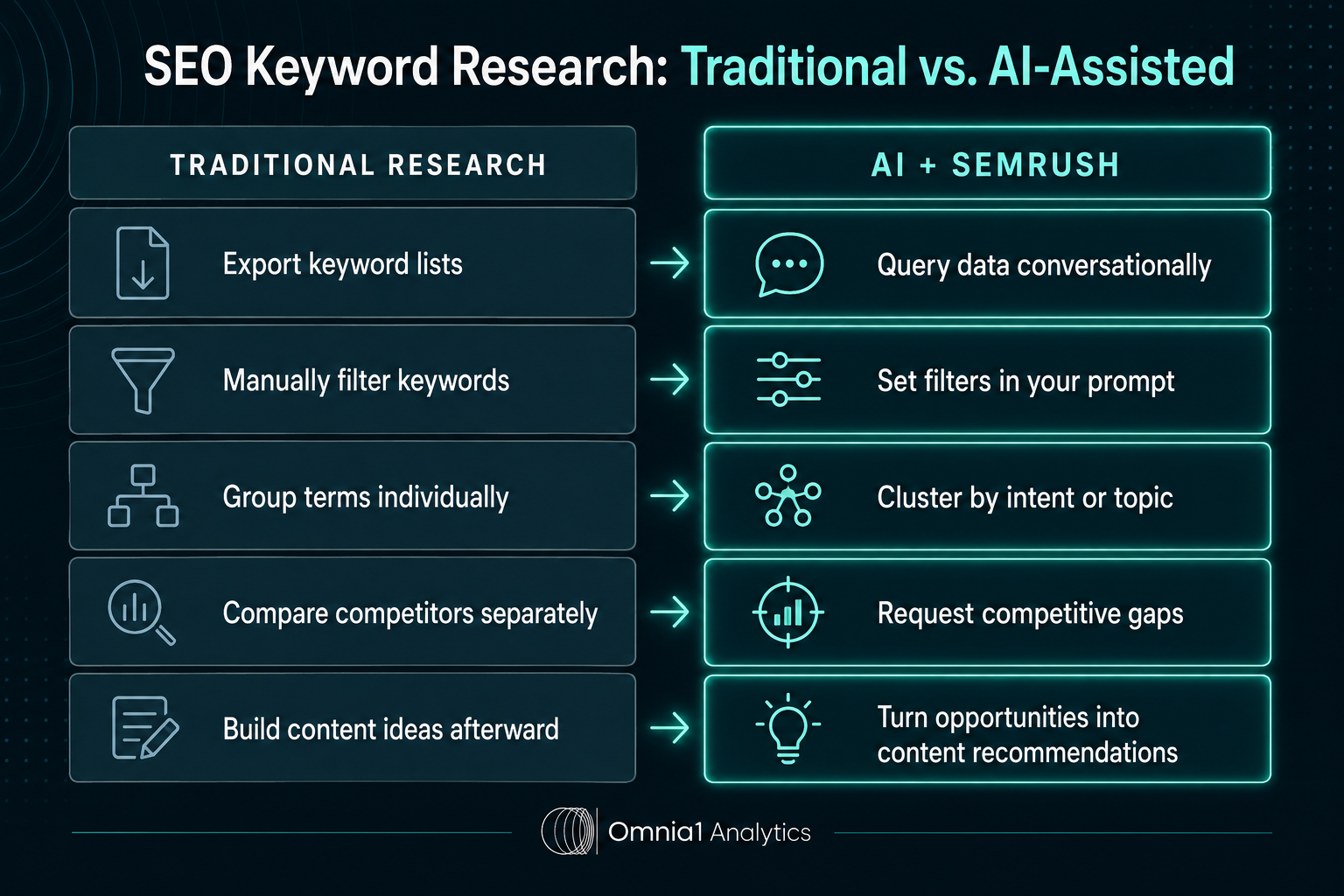
The goal isn't to remove SEO judgment. It's to spend less time manipulating data and more time deciding what to do with it.
How to Use ChatGPT With Semrush for Keyword Research
Semrush is available as an official ChatGPT app. Once connected and authenticated, you can reference Semrush directly when asking ChatGPT to conduct research.
For ecommerce brands, start with a specific product category rather than asking for "keywords for my website."
ChatGPT Keyword Research Prompt
“Using @Semrush U.S. data, conduct keyword research for a D2C ecommerce brand selling [PRODUCT/CATEGORY]. Find 30 relevant non-branded keywords and include monthly search volume and keyword difficulty. Group them by search intent and recommended page type: product page, collection page, buying guide, or informational blog. Prioritize 5 opportunities with the strongest balance of relevance, search demand, and achievable difficulty. Then identify 3 competitor keyword gaps we should investigate next.”
This gives ChatGPT both a dataset to work with and rules for turning that data into something actionable.
How to Use Claude With Semrush for Keyword Research
Semrush also offers a direct Claude integration. After connecting the Semrush app, marketers can use Claude to query the same underlying SEO data without manually moving information between platforms.
Claude can be particularly useful when you want to take a larger keyword set and develop a structured content or topical authority plan.
Claude Keyword Research Prompt
“Use @Semrush to build an SEO opportunity map for a D2C ecommerce brand selling [PRODUCT/CATEGORY]. Start with the U.S. database and identify relevant head terms, mid-tail keywords, low-competition opportunities, and question-based searches. Include search volume and keyword difficulty. Cluster overlapping terms by intent, recommend whether each cluster needs a collection, product, or informational page, and flag keywords where creating a new page could cause cannibalization with another cluster. Finish with the 5 opportunities you would prioritize first and explain why.”
4 Ways eCommerce Brands Can Take This Further
Once your initial research is complete, don't start a new conversation. Keep building on the data.
- Find quick wins: Ask for relevant keywords below a specific KD threshold where your site does not currently rank well.
- Run competitor gaps: Compare your domain against two or three direct organic competitors.
- Map keywords to existing URLs: Determine whether an existing PDP, collection, or article should be optimized before creating something new.
- Build topic clusters: Turn informational opportunities into supporting content that strengthens your core commercial categories.
This is where AI-assisted keyword research becomes more valuable than simply generating a list of terms.
AI Keyword Research Still Needs Human SEO Strategy
Connecting Semrush to ChatGPT or Claude doesn't put keyword research on autopilot.
Search volume and difficulty do not tell you whether a keyword makes sense for your products, margins, audience, existing authority, or broader acquisition strategy. AI can also misinterpret data or make poor recommendations, which is why Semrush itself recommends verifying AI-generated outputs before using them for important decisions.
Use the integration to accelerate research, not outsource strategy.
For D2C brands in particular, the best keyword isn't always the one with the highest volume. A smaller query that maps cleanly to a high-margin collection or high-intent use case can be far more valuable.
FAQs
- Can ChatGPT or Claude replace a keyword research tool?
- Not reliably. AI is excellent at clustering, analyzing, and interpreting keywords, but connecting a source like Semrush gives it real search volume, difficulty, ranking, and competitive data rather than relying on generated estimates.
- Should ecommerce brands create a page for every keyword cluster?
- No. Closely related keywords often belong on the same page. Before creating a new URL, compare intent and SERP overlap to determine whether you need a new page or should strengthen an existing PDP, collection, or article.
- How can I use AI keyword research to find quick SEO wins?
- Ask Semrush-connected AI to filter opportunities by relevance, current ranking position, search volume, and KD. Keywords where you already rank on pages two or three can be especially useful optimization candidates.
- Can Semrush MCP help identify ecommerce competitor gaps?
- Yes. Semrush MCP provides access to competitive and organic search data, allowing an AI assistant to compare domains and identify keyword overlap or gaps.
- What should I do after AI identifies my target keywords?
- Validate the SERP manually. Look at what types of pages currently rank, assess whether your site can satisfy that intent, check for cannibalization, and then decide whether to optimize an existing URL or create a new one. AI can shorten the research process, but that final strategic decision still matters.
Ready to grow your brand’s visibility across search engines and LLMs? Let’s build a strategy that helps your business get found wherever your customers are searching.